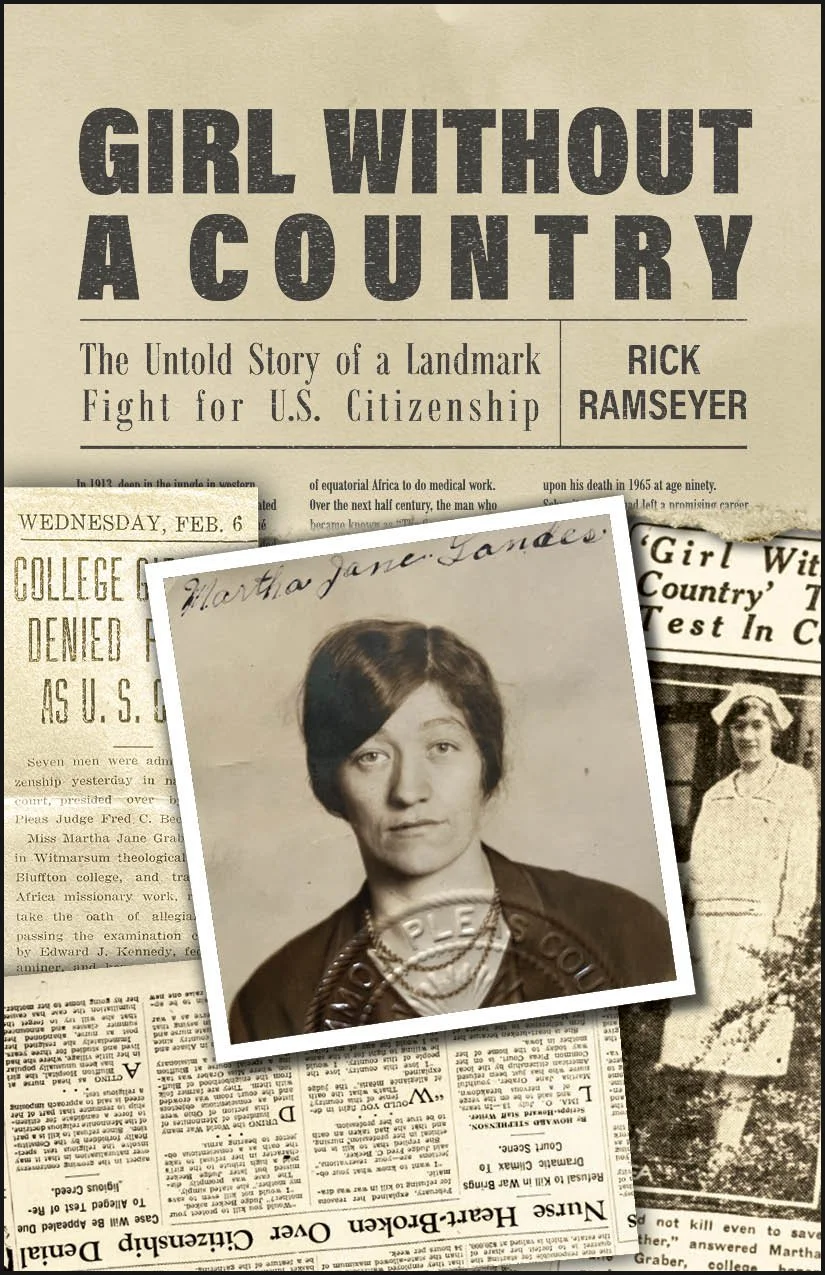
Should willingness to kill be a requirement for U.S. citizenship? Girl Without a Country tells the compelling, confounding story of Martha Graber―a Mennonite, registered nurse, and conscientious objector who in 1929 was twice denied citizenship because she refused to say she would take up arms to defend the United States. The denials, which came despite Martha's pledge to give her life for her adopted country, caught the attention of a diverse group of peace advocates, religious leaders, lawyers, and politicians, setting up a climactic third court appearance that was covered by newspapers nationwide.
Martha’s nineteen-month fight for citizenship features dramatic testimony, historical insights, and interesting backstories that stretch from Alsace-Lorraine in western Europe to America’s heartland. Elegantly written by Martha’s maternal grandson with never-before-published details and closely connected with a controversial Supreme Court decision, Girl Without a Country surfaces an array of topical issues, ranging from pacifism and patriotism to immigration and conscientious objection. Perhaps most importantly, Martha’s story considers what it truly means to be an American.
NEW! Listen to Rick’s conversation with Dr. Miranda Melcher, a host for the New Books Network, at https://lnkd.in/gt6qm9U7.
Order Now!
Girl Without a Country was published in August 2026 by Purdue University Press. Buyers will receive a 30% discount by using the code Purdue30 at checkout.
You can also order from Bookshop.org, which supports local bookstores, or any online bookseller, including Amazon and Barnes & Noble.
"Rick Ramseyer presents an intimate and well-researched portrait of a conscientious objector, Martha Graber, who remained true to her pacifist convictions even when American citizenship was on the line. In writing about Graber, who was also his grandmother, Ramseyer deepens our understanding of what it means to love God and country. He makes an important contribution to the history of conscientious objection and the study of citizenship." —Duane Stoltzfus, author of Pacifists in Chains: The Persecution of Hutterites during the Great War
"Nearly a century ago, a Mennonite nurse in rural Ohio named Martha Graber Landes mounted a legal challenge that pushed an important question to the forefront of the national consciousness. Would this nation grant citizenship to a deeply committed individual who would serve it in every way short of taking life on the battlefield? In recounting his grandmother's struggle, journalist Rick Ramseyer narrates an engaging stand for conscience that has deep resonance for our own day. This is an important book." —Perry Bush, emeritus professor of history, Bluffton University
“I highly recommend this book, a compelling story about a nurse who is put through the federal government’s wringer in the 1920s and never backs away from her principles. Relevant to today. Read, share, recommend.” —Michael Norton, author of Chasing Maine's Second: A Fight for Congress in Paradise
“This fascinating story documents and preserves an important but little-known episode in our nation’s history. It is thoroughly researched and has the added touch that comes with the author being the grandson of the subject of the book. It’s a lively read that reads more like a novel than a history book.” —Clarke Canfield, author of Those Damned Yankees: The Not-So-Great History of Baseball’s Evil Empire
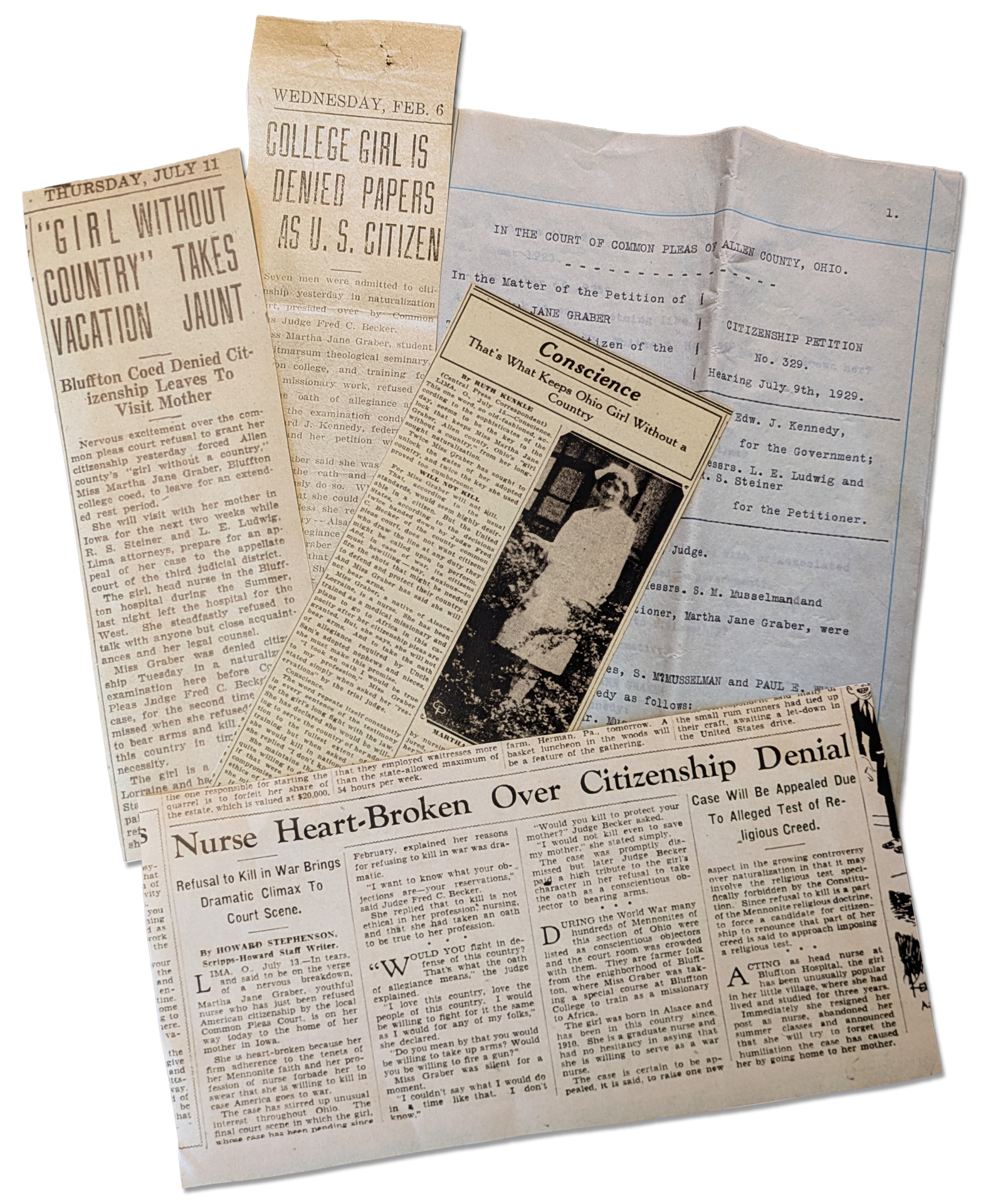
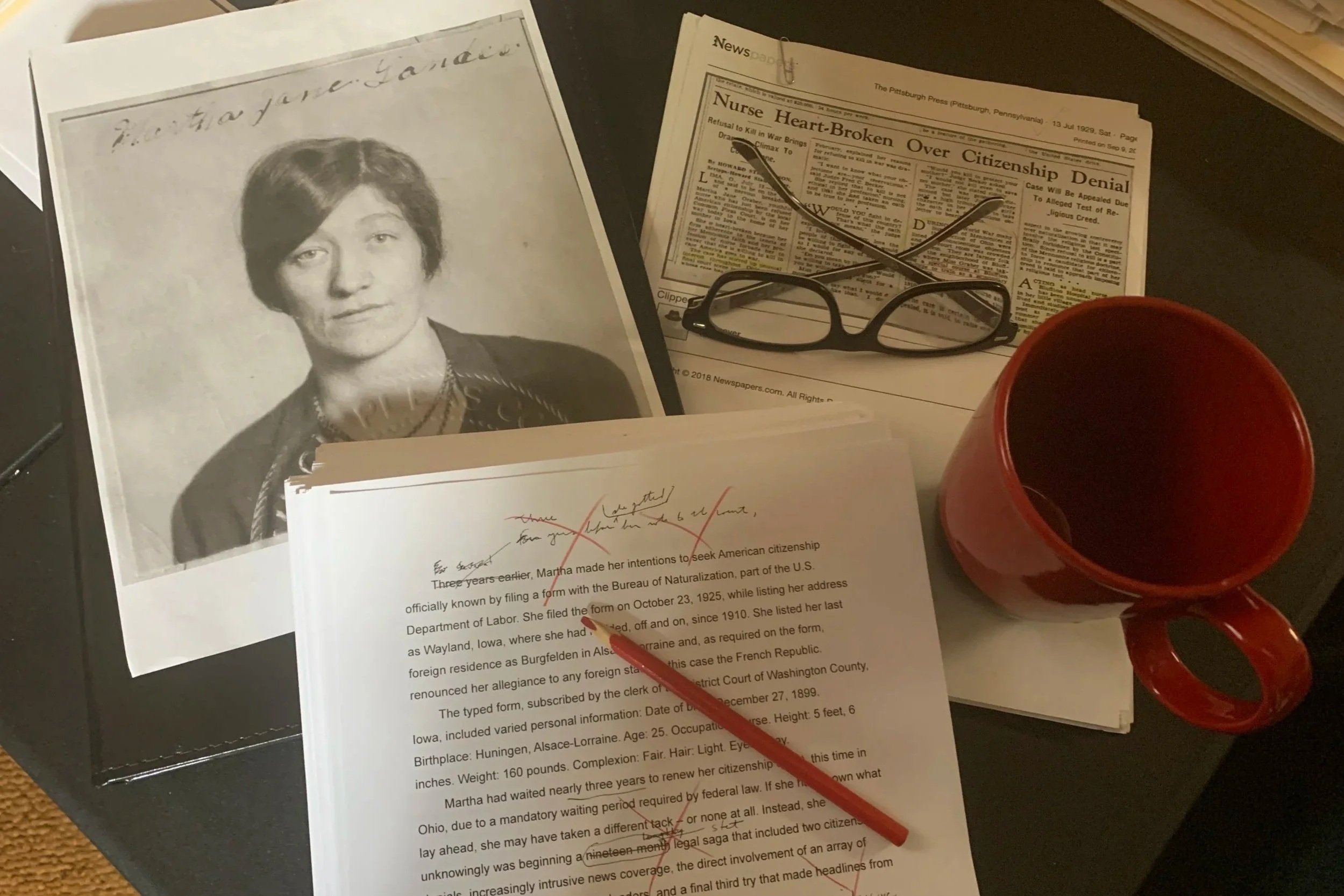
More than forty years ago, I was poking around the basement of my parents’ home in Bluffton, Ohio, when I came across an unfamiliar cardboard box in a closet beneath the stairs. The box was about the size of a file drawer, yet light as I hefted it, with no obvious markings. My teenage curiosity sufficiently piqued, I set it on the carpeted floor and looked inside. The box contained several well-stuffed, legal-size manila envelopes, the first of which was labeled, in shaky black cursive, “Clippings from newspapers when I went thru my citizenship deal in 1930 in Lima, Ohio.”
I opened one of the envelopes and pulled out a handful of documents and yellowed clips. One of the headlines was from a newspaper story dated July 13, 1929, with a histrionic headline: “Nurse Heart-Broken Over Citizenship Denial,” and, in smaller typeface, “Refusal to Kill in War Brings Dramatic Climax to Court Scene.” Another headline was from The Columbus Dispatch: “Wouldn't Kill to be Citizen.” A third was from July 29, 1930: “Conscience Keeps Ohio Girl Without a Country.”
It took me a moment to realize the “girl” in question was my quiet, reserved grandmother, Martha, who from my young perspective was the least likely person to make headlines of anyone I knew. At the time, my grandmother—a French immigrant and Mennonite who’d come to America in 1910—was widowed and living in a small apartment a few miles away, and the box apparently had made its way to our house for storage.
I sifted through more clippings and official-looking letters and court documents, and read sections here and there before I put everything away and returned to the in-the-moment focus of a middle schooler. I vaguely recall asking my mother about what I’d found, but her answer apparently wasn’t compelling enough to compete with my budding preoccupation with girls, basketball, and Frederick Forsyth thrillers. The box and its contents were, for the most part, forgotten.
Decades later, well after my grandmother’s death in 1982, my mother presented me with a family scrapbook she’d spent months preparing. Among the scores of pictures it contained were a handful of black-and-white snapshots of my grandmother. As I studied them, long-distant memories returned of a soft-spoken woman who kept her shoulder-length gray hair in a bun, wore horn-rimmed glasses, and favored simple cotton dresses and plain, dark shoes.
More memories surfaced. She was kind, formal, and not especially warm, with a tendency to hold herself erect with her head high. She preferred being called Grandmother—never Grandmom or Grandma or Nana. I don’t recall her ever raising her voice to me, though she was something of a disciplinarian. She often used the word “child” to address me, such as when I’d eat something too quickly: “Child, you’re going to give yourself a stomachache.”
She also had an ironic way of using “hurrah,” which I was reminded of when I came across a postcard in the family scrapbook. My sister, Marty, had sent the card to me in the summer of 1969 while she was visiting my grandparents in the small town of Straughn in central Indiana. My grandmother had added a postscript to my mother: “Hello. Cold morning. We fed our animals. The glass of root beer Dad bought I just emptied all over in the refrig. Hurrah. Love, M.”
A devout Christian throughout her life, Grandmother prayed frequently and read devotions daily, usually as she sat at the kitchen table with a cup of black coffee. She did not smoke or drink, and in fact, well into her fifties, was upset to learn that my parents were using a liquor box to store items during a move.
I’d received the scrapbook from Mom shortly after I became a father for the first time, and I was interested enough in my family’s history by then that I asked her to send me the materials I’d seen, years earlier, in the box in the basement. She brought them with her on one of her trips to my home in Maine.
Seeing the packet again was a revelation. It contained dozens of newspaper clippings, many of them written in a style that present-day readers may find condescending, with descriptions of my twenty-nine-year-old grandmother as a “pretty coed,” “youthful nurse,” and a “girl who has been unusually popular in her little village.”
The packet also held transcripts of my grandmother’s testimony in court in 1929—including her answers to questions that were later described by a U.S. congressman as “heckling” and “interrogation”—along with hundreds of personal journal entries, letters, and photographs. One of the photos shows my grandmother just after her final court appearance. She is wearing a dark dress with a double-strand necklace, and her long brown hair is pulled back. She is staring directly into the camera, unsmiling, with a resigned—some might say sad—expression.
For the first time in decades, Grandmother came alive for me. Who was this woman from Alsace-Lorraine? What happened to her in that courtroom in Lima, Ohio? How did it affect the rest of her life? And what is the legacy of her case?
A few years later, I was hiking Mount Katahdin in Maine with Steve Visser, a friend from journalism school. A former reporter for The Atlanta Journal-Constitution, Steve began talking about a court case he was considering turning into a book.
“What about you?” he asked. “Are you working on anything?”
I found myself sharing a few details of my grandmother’s story: the box in the basement, the transcripts, the national headlines, her staunch pacifism.
“Brother,” Steve said, nearly shouting, “that’s a book.”
We continued to climb, and I could feel my excitement build. It was a book, a story that had never been fully told and, with immigration, citizenship, and what it truly means to be an American again in the news, one that could not be more timely.
That prescient conversation rekindled my painstaking journey to research and write this extraordinary chapter of my grandmother’s life and chronicle her unique, significant connections and contributions to the history of conscientious objection. It is a remarkable, confounding, and sometimes infuriating story that generated hundreds of newspaper articles in 1929 and 1930, sparked the direct involvement of a who’s who list of stakeholders, fueled a combative U.S. congressional hearing, and cemented her close ties to several other prominent citizenship petitions, one of which went all the way to the U.S. Supreme Court.
As I uncovered more and more information, I became convinced it was an important book that I was destined to write. Even if it was never published, I began to think of it as a gift to my two children: This was your great-grandmother, Martha Jane Graber Landes. She was an immigrant. A nurse. A minister’s wife. A mother. A pacifist. And ninety-seven years ago in an Ohio courtroom, a fighter.
Rick Ramseyer
January 31, 2026
Cumberland Center, Maine
A former newspaper reporter and magazine staff writer, Rick Ramseyer has been researching and writing the story of Martha Graber for the past decade. His interest in her remarkable citizenship quest extends well beyond documenting an important aspect of U.S. history: Martha was his maternal grandmother.
Rick has a bachelor’s degree in communication from Bluffton University and a master’s degree in journalism from the University of Missouri. In 2018 and 2019, he was awarded writing residencies at the Hewnoaks Artist Residency in Lovell, Maine, where Girl Without a Country took shape.

-
Saturday, August 15: Publication date for Girl Without a Country: The Untold Story of a Landmark Fight for U.S. Citizenship
Podcast appearance, "New Books with Miranda Melcher," The New Books Network, an international podcast consortium dedicated to author interviews and public education. Listen here.
-
Sunday, September 13: “Mennonites and the Constitution.” Sermon, 10:30 a.m., First Mennonite Church, 101 S. Jackson Street, Bluffton, Ohio.
Tuesday, September 15: “Steadfast Faith: Martha Graber’s Landmark Fight for U.S. Citizenship.” Constitution Day Forum Presentation, 11 a.m., Yoder Hall, 1 University Drive, Bluffton University, Bluffton, Ohio.
Tuesday, September 15: Book launch, 4 p.m., Reading Room, Musselman Library, Bluffton University, 221 N. Bentley Road, Bluffton, Ohio.
Wednesday, September 16: “Girl Without a Country: A Bluffton Woman’s Landmark Fight for U.S. Citizenship.” Presentation, 5:30 p.m., Bluffton Public Library, 145 S. Main Street, Bluffton, Ohio.
Friday, September 18: “Girl Without a Country: A Bluffton Woman’s Landmark Fight for U.S. Citizenship.” Presentation, 2:30 p.m., Maple Crest Senior Living Village, 700 Maple Crest Court, Bluffton, Ohio.
-
Saturday, October 10: Book signing, 1 to 3 p.m., Sherman’s Maine Coast Book Shop, 49 Exchange Street, Portland, Maine.
Saturday, October 24, Book signing, 1 to 3 p.m., Books-A-Million, 430 Gorham Road, South Portland, Maine.
-
Saturday, November 14: Author presentation, 10 to 11 a.m., Prince Memorial Library, 266 Main Street, Cumberland, Maine.